Topics

October 19, 2026



October 19, 2026
It’s easy to be tempted by pure volume when you’re looking for a participant panel: after all, it only seems natural that the more participants available, the more chance you’ll find the perfect fit.
But panel participants aren’t always as they appear at first glance.
A recent study conducted by the Proceedings of the National Academy of Sciences (PNAS) found that across seven different research platforms, between 6-41% of participants failed validated AI detection tests.
In other words, a good chunk of that massive panel you’re eyeing may actually have a surplus of AI agents or humans copying and pasting LLM answers into your study.
Without consistent and systematic monitoring and vetting of your participants, it’s easy to point your team towards deeply flawed product decisions.
A good chunk of that massive panel you’re eyeing may actually have a surplus of AI agents or humans copying and pasting LLM answers into your study.
Here’s what you should be looking for in a panel beyond just the numbers—so you can prevent mistakes that cost a lot more down the line.
The rise of automated survey bots, click farms, and AI-generated text has made participant fraud a major concern. As enterprise teams distribute research access across non-researchers, they need automated guardrails to ensure that rogue data never enters their analytics pipelines.
Vetting trust can’t be an afterthought or an isolated feature; it should be integrated into the framework. That includes:
When these trust practices operate behind the scenes, product managers and designers can launch studies with complete confidence, knowing every insight stems from a verified and vetted human who isn’t cutting corners.
As the speed of product development increases, momentum is non-negotiable. But few things derail a product roadmap faster than launching a study only to wait days for participants who never materialize, or who drop off midway through a multi-day test.
True panel engagement isn’t measured by a huge list of inactive email addresses collected years ago. A healthy, dependable participant pool consists of active, opted-in contributors who regularly participate in studies.
A couple great indicators for an active panel:
An active panel delivers distinct advantages for scaling teams:
Standard quantitative surveys are great at identifying what is happening—for example, showing where users drop off at a specific checkout step, or that feature adoption dipped after a redesign. But quantitative metrics can’t explain why someone hesitated, what caused their frustration, or what emotional touchpoint drove them away.
Real product breakthroughs happen when teams get the full qualitative context. Instead of asking participants to check static boxes, high-quality research panels invite them into media-rich formats. For example:
Pulling from a panel with broad demographic representation—spanning income levels, education backgrounds, and geographies—ensures your findings reflect how real customers live, evaluate products, and make decisions.
Enterprise teams often face a false dilemma: move fast by cutting research corners, or conduct rigorous studies that stall delivery. But rushing into research with unvetted panels creates an expensive illusion of speed.
When teams recruit from low-quality pools, the downstream costs are severe:
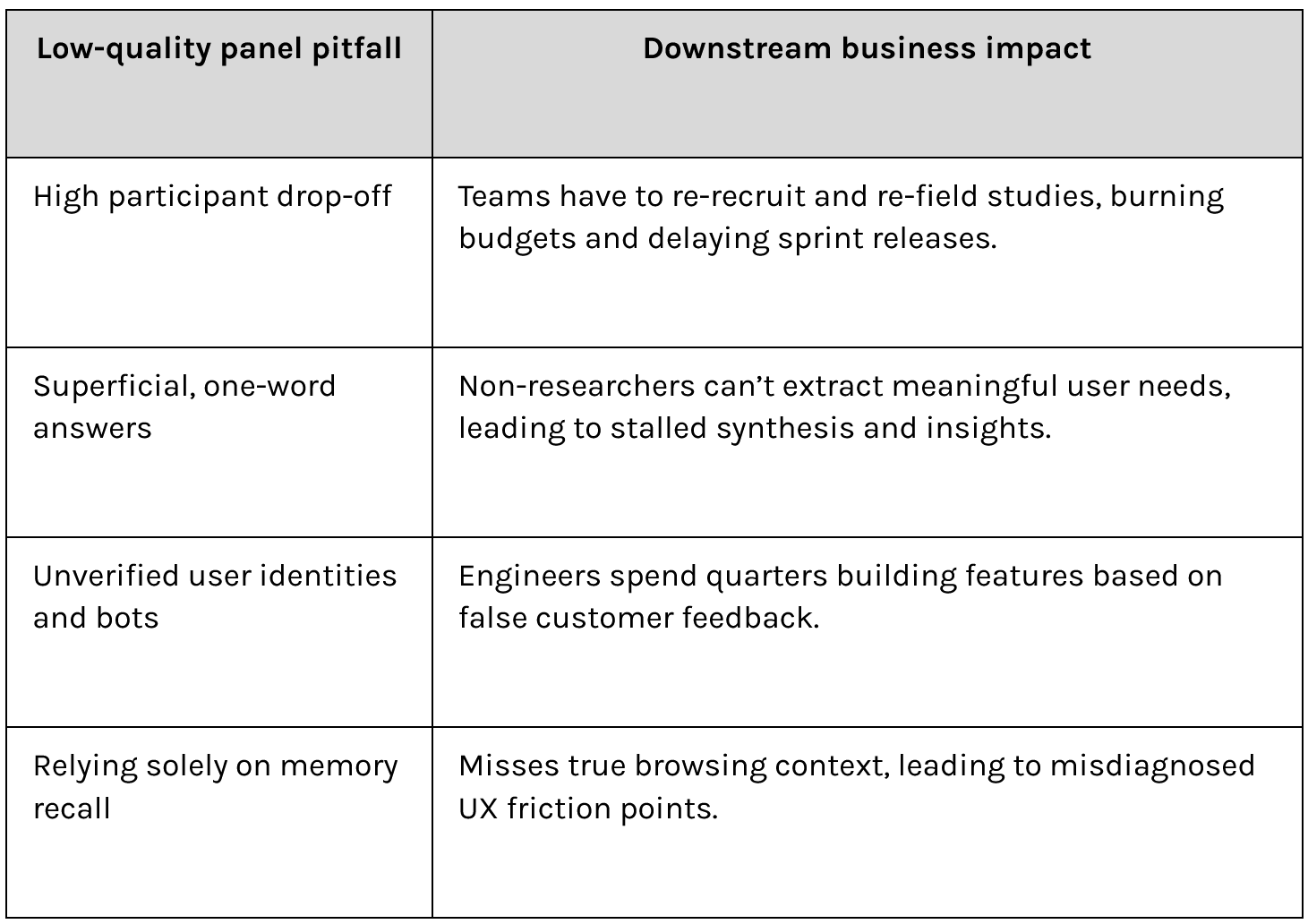
Doing research the right way the first time means capturing real behavior in context, rather than relying on questionable user recall. When teams observe real people navigating actual websites, apps, and physical environments, they uncover authentic behaviors that point directly to solutions.
Getting it right on day one protects both the product roadmap and the organization's trust in user-centered design.
It’s easy to be seduced by a massive panel. But at the end of the day, frequent vetting and engaged human participants is what will make the difference between a study that’s gone off the rails and one that points your team in the right direction.
When assessing panels, consider evaluating your providers and tapping into outside feedback for the following:
Having clear answers to these questions can help ensure you’re choosing from the best possible pool of participants for your next study.
As enterprise teams adopt AI-assisted workflows to scale research, Dscout provides the human foundation that makes that scale dependable.
Dscout’s platform and community are built to solve quality challenges:
See how we can help your team conduct high-quality research the first time around.