Topics

January 22, 2026
.png)

January 22, 2026
The rise of AI has introduced a flood of new research tools and raised new questions. Mergers, partnerships, and shifting use cases are blending the lines between platforms that once served very different purposes.
At the same time, team roles are evolving. Designers are doing research. Researchers are shaping AI. Marketers are testing usability. The lines are blurrier than ever.
This quick breakdown is here to help. Whether you're exploring new options or trying to make sense of a crowded toolstack, we’ll help you navigate what’s out there and choose what works best for your goals.
As we said, there are a LOT of options out there. But which one is the right fit for your organization’s current and future needs? A quick walkthrough of each…
Tools like Qualtrics and Alida are built for…
They're great for validating ideas and monitoring customer experience over time. But when it comes to informing product decisions, these tools often fall short. That’s because they’re built to tell you what’s happening—not why.
You’ll get quantified trends, but little context. Confirmation, but not understanding. And when teams need in-the-moment behavior, deeper emotions, or organic reactions? These tools can’t quite keep up.
Interview tools like Discuss or Recollective help you connect with people for 1:1 or group conversations. They're useful when your goal is to build empathy and hear firsthand stories. Some offer AI features to summarize takeaways or analyze trends across sessions.
But there are limits…
They’re helpful when bandwidth is tight, or you need quick qualitative data—but they weren’t built for scalable, in-context research or follow-ups based on real-world behavior.
Experience Research Platforms like Dscout help teams understand people in the real world, not in hindsight. Instead of relying solely on what someone says happened, you can see what actually happens as it’s happening.
With Dscout, you can…
And if you still need surveys or interviews, you’re covered! Comprehensive experience research platforms also support media surveys and 1:1 interviews, plus the ability to go deeper with moderated or unmoderated follow-ups that uncover the “why” behind the “what.”
But there are a few additional things to keep in mind…
Experience Research Platforms tend to come with a higher price tag since they cover the full research workflow, from recruiting to shareouts, and offer a wide range of methods.
That depth and flexibility are powerful, but:
As a whole, Experience Research Platforms help you quickly move from observation to insight and then back those insights with evidence your stakeholders can’t ignore.
Just to make things more interesting, panel providers like User Interviews and Respondent often get tossed into the mix. They’re great when you need niche participants or quick scale, and they tend to play nicely with most research tools out there.
Repositories like Marvin and Dovetail also integrate well, making it easier to store, tag, and revisit research across platforms. They’re not for fielding research, but they’re helpful for making sense of it all afterward.
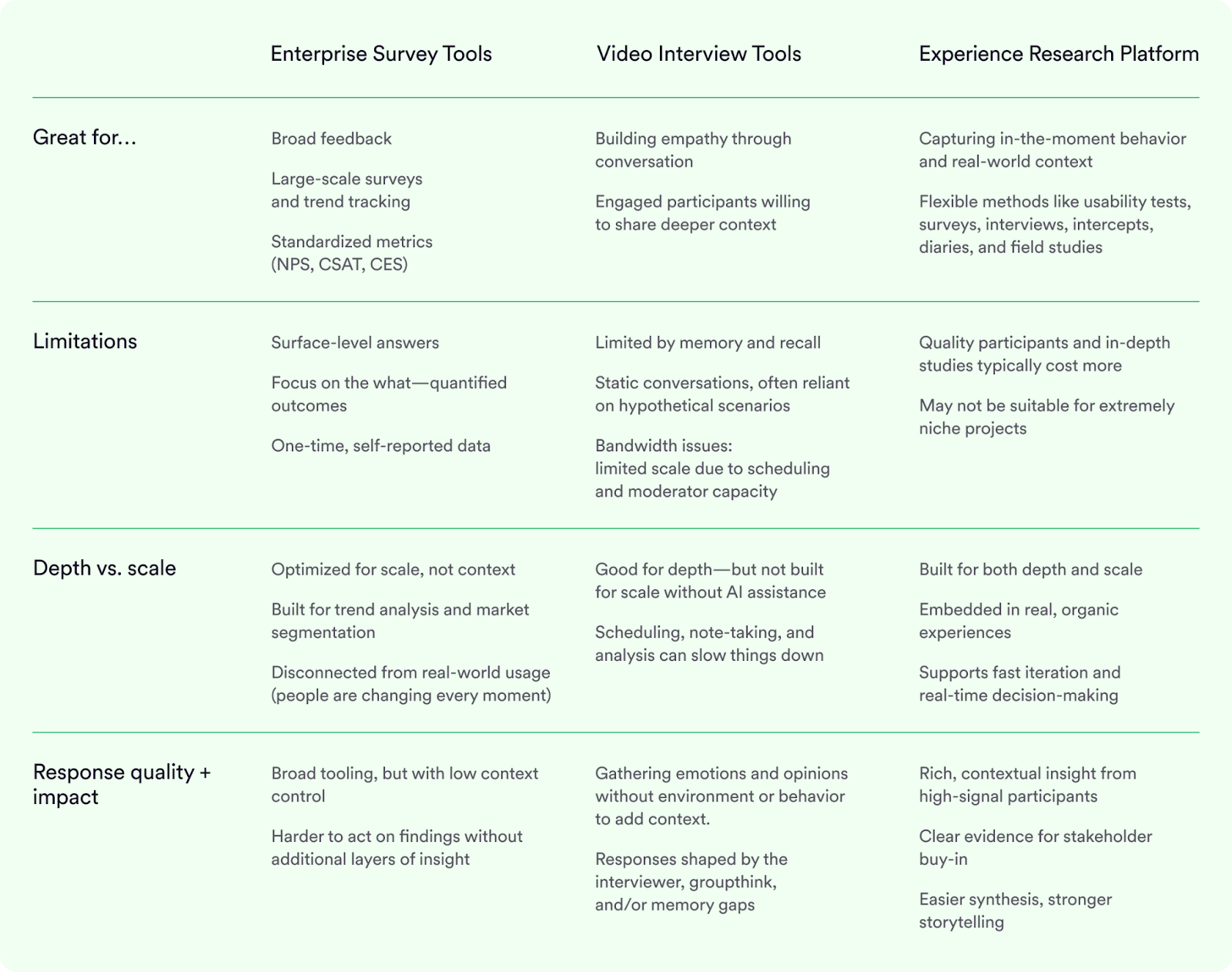
If your job is to measure experience, survey tools might be enough. If it’s to collect opinions about experiences, interviews might work.
But if your goal is to deeply understand and improve experience, experience research platforms make all the difference.
Product and UX teams choose platforms like Dscout because they can:
Since we’re talking about the research industry, may as well do some triangulation!
To make a confident, well-rounded decision, it’s essential to balance what you hear from vendors with real-world signals.
Here’s where else to look…
Taken together, these signals help you move beyond marketing claims and understand how a tool performs in the real world. The goal isn’t just to pick a platform—it’s to choose one your team can actually succeed with.
Choosing the right research platform isn’t about checking every box—it’s about checking the right ones.
The tools you’ve used before might promise simplicity, but when it comes to making confident product and experience decisions, real insights matter most. You need tools that reflect how people actually live, behave, and feel—not just how they respond to a one-time survey.
That’s why specialized platforms like Dscout exist. We help you see the messy, emotional, contextual moments that actually shape behavior—and turn them into insights you can act on. Fast.
So as you evaluate your research toolkit this year, ask yourself:
It's time to trade tools of the past for ones that let you actually see your customers' genuine, organic behaviors and reactions in real time, at scale.
Because in experience research, focus wins. And Dscout was built for focus.