People Nerds

The Levers Framework: Understanding What Drives Customer Decisions

July 29, 2026

overview

The Levers Framework breaks down what drives customer decisions into 5 key factors: Cost, Trust, Usability, Comprehension, and Motivation.

Contributors

Harriet Swan

Director of UX Research at GAIN Conversion

The Levers Framework: Understanding What Drives Customer Decisions

July 29, 2026

Overview

The Levers Framework breaks down what drives customer decisions into 5 key factors: Cost, Trust, Usability, Comprehension, and Motivation.

Contributors

Harriet Swan

Director of UX Research at GAIN Conversion

Harriet Swan and the team at GAIN Conversion built the Levers Framework to solve a problem every team runs into: everyone has a theory about why users convert, and those theories rarely line up. Research says one thing, marketing says another, product's testing something else entirely.

This framework was designed to give everyone a shared way to talk about it.

What is a "lever"?

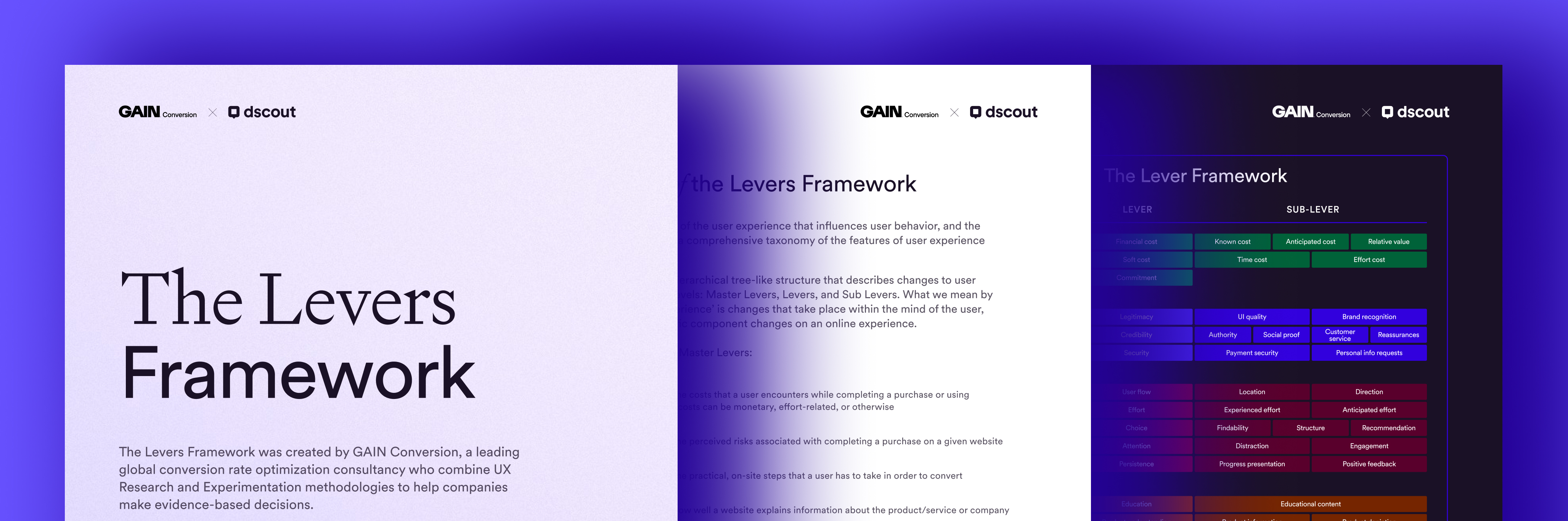
A lever is a feature of the user experience that shapes behavior (think trust, cost, or how easy something is to use). Instead of vague hunches about why a page isn't converting, you can point to the specific lever at play and know what to test or research next.

How the framework is structured

The framework works like a tree, with three levels of detail:

  1. Master levers — the five big forces behind every customer decision: cost, trust, usability, comprehension, and motivation.
  2. Levers — each master lever splits into more specific ones. Cost, for instance, breaks into financial cost, soft cost, and commitment.
  3. Sub-levers — and those break down even further. For example under cost, you'll find known cost, anticipated cost, relative value, time cost, and effort cost.

An overview of the five master levers

  • Cost — what a user has to give up, financially or otherwise.
  • Trust — how safe or credible the experience feels.
  • Usability — how easy it is to actually get things done.
  • Comprehension — how well a user understands what's on offer.
  • Motivation — what's in it for them.

How teams actually the Lever Framework

  • Ideation — take a research insight and figure out what to do with it.
  • Iterative learnings — decide where to spend your testing and research time.
  • Repository and meta-analysis — tag insights by lever so patterns show up across teams instead of staying buried in silos.

Conversion rarely comes down to one big fix. It's usually a handful of small, specific frictions. Perhaps a cost that feels too high, a trust signal that's missing, or a step that's harder than it needs to be.

The Levers Framework gives you the vocabulary to name those frictions precisely, so your team stops debating what the problem might be and starts testing what actually moves the needle.


HOT off the Press

More from People Nerds

Harriet Swan
https://www.linkedin.com/in/harrietswan/