Topics

August 12, 2026



August 12, 2026
This article is an adaptation of the webinar “Scaling and Sustaining an AI-Powered Research Program.” You can watch it in its entirety here.
AI works best when treated as a collaborator and not a replacement. You can save time on admin-heavy tasks like planning, recruiting, and note-taking, so your team can focus on synthesis, storytelling, and stakeholder relationships.
But the real key to success is to set boundaries early with a research charter, tie your work to business impact instead of report volume, and bring stakeholders in as co-owners of the process. Do that, and AI becomes a way to scale your impact, not just your output.
Unfortunately, that’s easier said than done! In a recent webinar, Paige Bennett, Founder and Principal Consultant at Users First AI and former Director of User Research at Affirm, and Stevie Vanderwiel, Senior Manager of Brand and Growth Marketing at Dscout, discussed where AI implementation can go astray (and how to course correct).
About a year and a half ago, user research teams were sold the promising vision that AI would handle tedious administrative tasks, giving them valuable time back for deep strategic work.
For Paige’s team, the initial expectation was clear: scale the lean team, increase project volume and scope, and deliver faster turnarounds without expanding resources.
In her scenario, the project output skyrocketed. They saw a huge increase in project volume, quadrupling it and expanding access across the organization.
But instead of gaining that time back the time for more strategic research…the goalpost moved.
There are many ways AI can go off the rails for research teams—usually not because the tool failed, but because the guardrails around it were never built. This can look like…
Before jumping in and using AI to speed up your entire research process, pause and consider where AI can actually provide the most value.
AI can genuinely help across…
AI still lacks…
The challenge is really in threading the needle. As researchers, how do we embrace the benefits of AI while also not succumbing to its biggest downfalls? That all starts with an AI integration map.
Successfully integrating AI requires mapping tools directly to specific stages of your research workflow where manual pain points exist. By pairing automation with human oversight at each step, you can streamline repetitive tasks without sacrificing rigor.
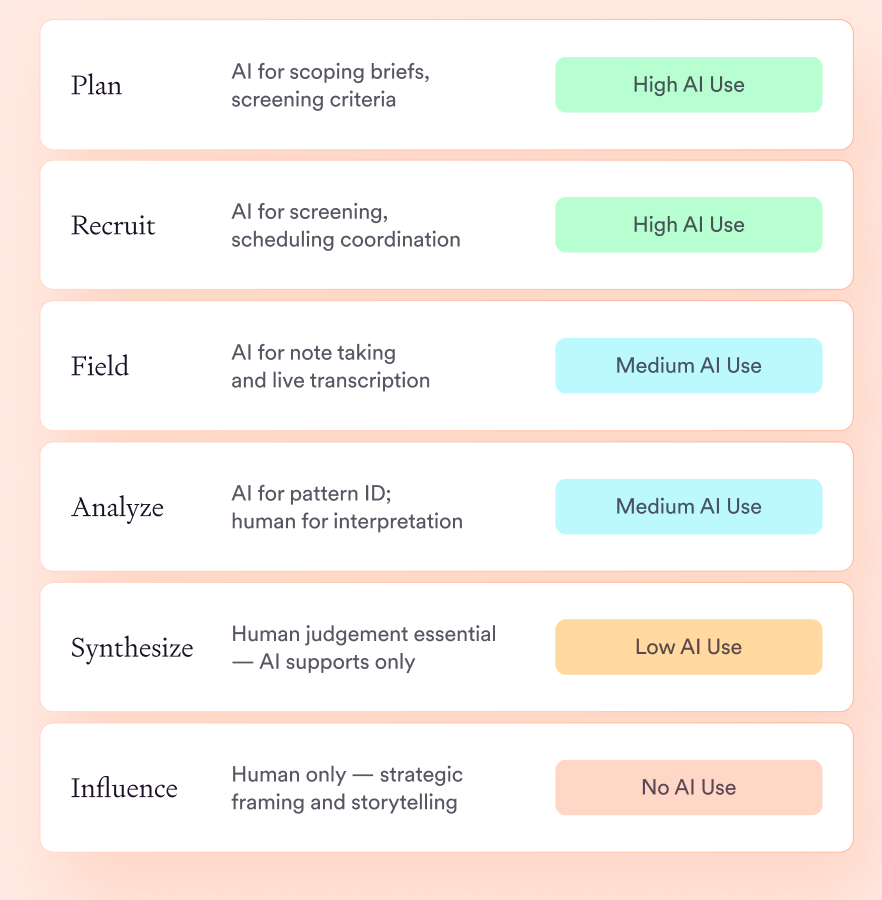
AI shines during initial scoping by generating scoping briefs, drafting templates, and establishing preliminary study criteria. This takes a massive administrative burden off lean research teams right from the start.
Automated tools are great at parsing participant screening criteria and managing logistically heavy candidate coordination. It speeds up finding the right participants at scale without manual overhead.
AI assists during live user sessions by handling automated note-taking and real-time transcript generation. This frees up the researcher to remain fully present and engaged with the participant.
Machine learning helps parse vast qualitative datasets and identify surface patterns across multiple interviews. It acts as an efficient starting point for initial thematic grouping.
Human judgment remains essential here, as AI serves only as a supporting partner to curate and refine patterns. Researchers can interpret the data directly to ensure nuances aren't lost in automated summaries
While AI can help brainstorm creative collateral like short summary podcast snippets, it can’t frame executive narratives. Strategic storytelling and stakeholder buy-in still require human empathy and contextual savvy.
Once you’ve figured out the best ways to implement AI, there’s still the massive challenge of defining success. Doing so means moving beyond basic operational numbers to evaluate true research impact. While leadership might naturally focus on turnaround speed and deliverable counts, real success relies on decision quality and stakeholder confidence.
It’s easy to confuse high project volume with meaningful business impact. When success is measured solely by how quickly reports are delivered, research becomes a commodity instead of a strategic lever. Delivering 90 mediocre reports quickly doesn’t move the business needle as effectively as guiding three major strategic product pivots.
As Bennett put it, "Speed to insight is different than speed of turnaround. One sets your team up for success, and one can put your team in a precarious position."
High-value research programs focus on metrics like decision quality, risk reduction, and stakeholder confidence. This ensures clarity is more important than just throughput.
Establishing clear guardrails is essential to protecting your team from burnout and a decrease in quality. By setting boundaries early, you can align expectations across the business and preserve your research’s integrity.
Revisit or build a charter that explicitly outlines:
This sets clear guardrails from day one, so stakeholders understand the scope and limits of automated research.
Shift the value conversation away from deliverable counts and instead consistently frame wins in terms of influencing decisions and avoiding risk. By showing how research impacts product strategy, stakeholders will be less likely to treat your team as a delivery factory.
As Bennett advises: "Bring your stakeholders into your AI program. Make them co-owners of that program, with guardrails, so that they're not just consumers of your output."
Transitioning away from reactive data collection allows you to step fully into strategic advisory roles. Using AI for administrative tasks frees up your time to solve higher-level business challenges instead.
It’s not easy dealing with the pressure of the volume and speed that comes with AI. Take a step back to align on what "better" actually looks like for your practice before scaling up AI tools. If you’re already in the thick of it, pause to evaluate where your process needs fine-tuning and how quality can be improved.
Define what success actually looks like for your research program before you start expanding your AI toolset. If you’ve already scaled up, take a step back to evaluate where your process is working and how your standards can improve.
View AI as a supportive partner that lightens your administrative load, rather than a substitute for your role. Make sure you actively protect the critical parts of the research process that require human judgment and nuance.
Setting boundaries around your AI usage isn't about adding bureaucracy or slowing down your workflow. Clear guardrails actually help your team move quickly while keeping you from turning into an overworked machine.
Pay close attention to whether leadership is getting overly fixated on total report volume and output speed. Gently shift their focus by showing how your research directly influences key product choices rather than just listing deliverables.
Focus on helping researchers build core skills like strategic framing and storytelling, so they don't overly rely on automated tools. If you manage or mentor others, actively empower them to move away from pure execution and step into strategic roles instead.
“The role of research is shifting, and it will likely look very different in the near future,” said Bennett. “But we do have this opportunity to make sure that we are moving away from [sheer output and towards] strategic thought. We as researchers are still the ones able to frame the right problems.”