Topics

September 16, 2026


September 16, 2026
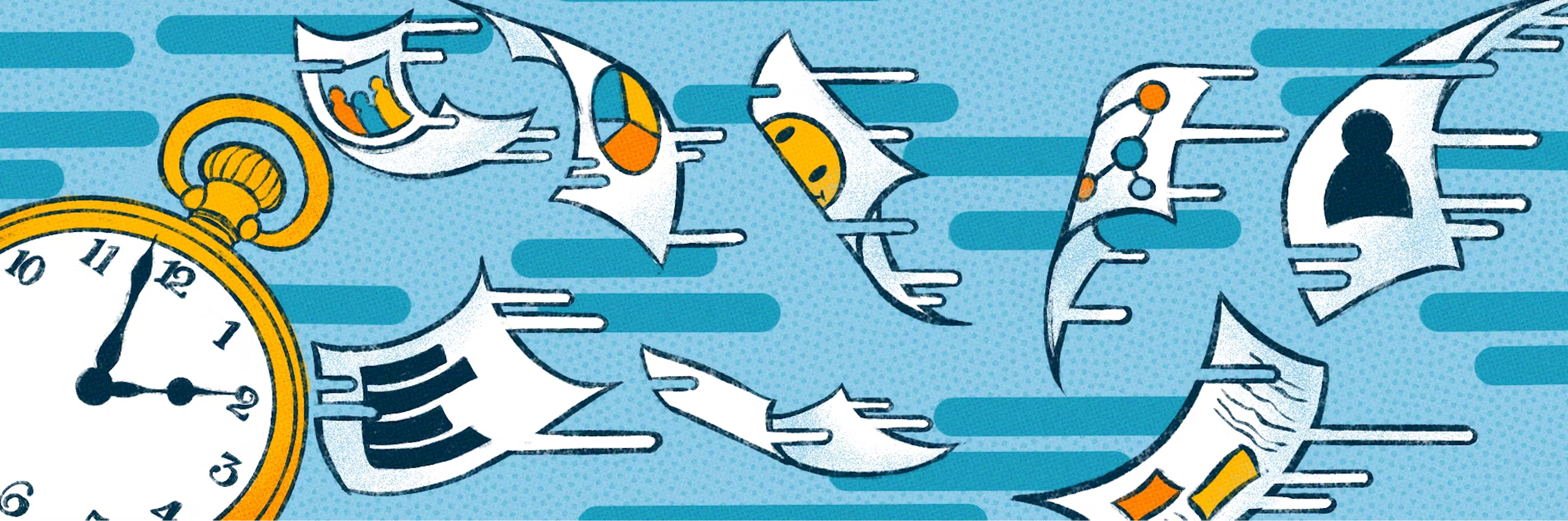
Every AI product has a gap now: the seconds or minutes between hitting send and getting an answer, usually filled by a spinner, a blinking cursor, or text streaming in one word at a time.
As AI takes on bigger jobs, that gap is stretching from a few seconds to a few minutes, sometimes much longer. It’s stopped being a footnote in the experience and started being a moment we have to design for.
We wanted real answers, not assumptions, so we ran three studies earlier this year.
One was an AI-moderated conversation with everyday chatbot users about how they wait, when they switch or give up, and how satisfied they are with the whole experience.
The other two were diary-style studies asking people to show us, in the moment, what they actually do while AI drafts, thinks, or runs a longer task in the background. One with folks from our own team, and the other with external UX researchers, designers, and product professionals across industries.
Together, the three studies let us ask the same question from a few angles: what fills the gap, and what does that gap do to people’s trust in… whatever is on the other end?
The people we talked to aren’t casual users. 87% chatbot users we interviewed use AI multiple times a day, while the rest use it daily.
But when we asked how satisfied they were with the way AI handles waiting, the average came out to 5.2 on a 7-point scale. They feel fine…but I wouldn’t say great.
That gap between how often people use these tools and how little the waiting experience impresses them is exactly the opportunity. I call it an opportunity on purpose, this waiting period IS the user experience after all.
Once wait times pass about 30 seconds or so, people stop watching and start doing something else: scrolling their phone, checking a second AI tool, answering an email, petting their dog. Among professionals running longer, agentic tasks, this isn’t idle time-killing, it’s a workflow.
People described running multiple AI tools in parallel, flipping between tabs, or stepping away entirely to grab coffee while something runs in the background.
“A lot of tab switching and doom scrolling while waiting for an answer.”
Length wasn’t the biggest trust problem in our data—ambiguity was. A spinner that doesn’t move got called “endless” more than once, and a stall with no explanation was the single most common trust-breaker across all three studies.
What helped: progress bars that visibly move, partial or streaming output, and visible reasoning steps. About a third of the chatbot users we talked to specifically asked for a time estimate, even a rough one.
“I always multitask while Claude is working. The challenge is that Claude often needs permission to keep going, so I’m always checking back—I don’t realize four hours later it’s not done yet.”
People will wait a long time for something that matters to them, especially if they’re mid-flow on a complex task, and they’ll abandon a trivial request in seconds if their favorite search engine is sitting right there, missing the days when they were the go-to tool. Wait tolerance had much less to do with the clock and much more to do with what was riding on the answer.
The more sophisticated the user, the less interested they were in being entertained during the wait. Both our own team and the external UX professionals we talked to pushed back on the idea of engagement features and asked instead for transparency: what’s the AI actually doing, and can I trust a notification to tell me when it’s done?
“I don’t like to go off and do something else, even if I know it may take a while to get a response, for fear that I may miss something or not know how the AI arrived at the response.”
If you design, research, or build AI products, a few things are worth taking from this:
Waiting on AI isn’t going away. If anything, as these tools take on bigger jobs, it’s going to take up more of our time, not less. The products that earn trust in that gap won’t be the ones with the cleverest loading animation. They’ll be the ones that tell the truth about what’s happening, and let people get on with their lives in the meantime.